Few things in space really catch our eye like an eclipse. For a time the sky gets dark it gets chilly and it gets really quiet outside. People have always been fascinated by these events from stories about dragons eating the sun to new discoveries in science.
There’s more to a solar eclipse than just looking cool. A lot of things happen in the environment in the air and in living things when the sun, moon and earth line up. If you’re going to see one of these events or just curious about space you might wonder: what actually happens during an eclipse?
Lets explore what happens during an eclipse.
The Cosmic Alignment: How It Works
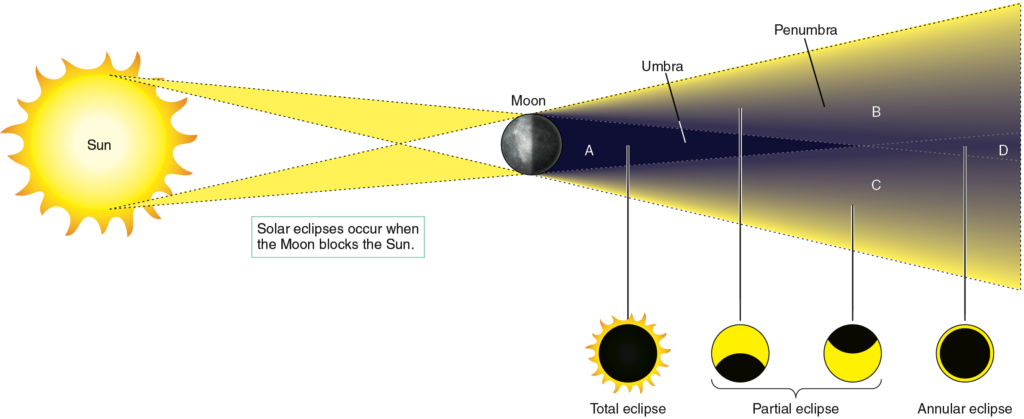
To understand an eclipse we need to look at how the sun, moon and earth line up. A solar eclipse can only happen when the moon is between the earth and the sun, which is during a moon. This is when the moon casts a shadow on the earth.
This alignment has to be just right. The moons path is tilted a bit compared to the earths path around the sun. So the three bodies don’t line up every month. When they do the moon casts two types of shadows on the earth:
- The Umbra: This is the part of the moons shadow. If you’re in this area the sun is completely. You see a total solar eclipse.
- The Penumbra: This is the part of the shadow. If you’re, in this area you see an eclipse, where the moon looks like its taking a bite out of the sun.
Step-by-Step: The Timeline of Totality
A total solar eclipse is not a flash of darkness. It is an dramatic progression that unfolds over several hours. Understanding this timeline is essential to appreciating the total solar eclipse experience.
1. First Contact (The Partial Phase Begins)
The total solar eclipse begins when the edge of the Moon first touches the disk of the Sun. To an observer wearing certified eclipse glasses it looks as though a tiny crescent has been carved out of the Sun. Over the hour or so the Moon slowly slides further across the solar face of the Sun.
2. The Changing Light and Temperature Drop
When roughly 70% to 80% of the Sun is covered by the Moon the environment begins to change dramatically during the total solar eclipse. The daylight takes on a quality it looks metallic or silvery. Shadows become incredibly sharp and crisp because the source of light has narrowed from a sphere to a sliver of the Sun. At the time you will begin to notice a chill in the air as the local solar radiation drops during the total solar eclipse.
3. Shadow Bands and Baily’s Beads
In the final minutes before totality, two beautiful phenomena occur:
- Shadow Bands: you can see faint rapidly moving wavy lines of light and dark moving across flat light-colored surfaces on the ground. This happens because the last narrow rays of sunlight are passing through the layers of Earth’s atmosphere.
- Baily’s Beads: seconds before the Sun is fully covered by the Moon, a string of brilliant points of light appears along the edge of the Moon. This happens because the last remaining rays of sunlight are streaming through the valleys and craters, along the rugged lunar landscape of the Moon.
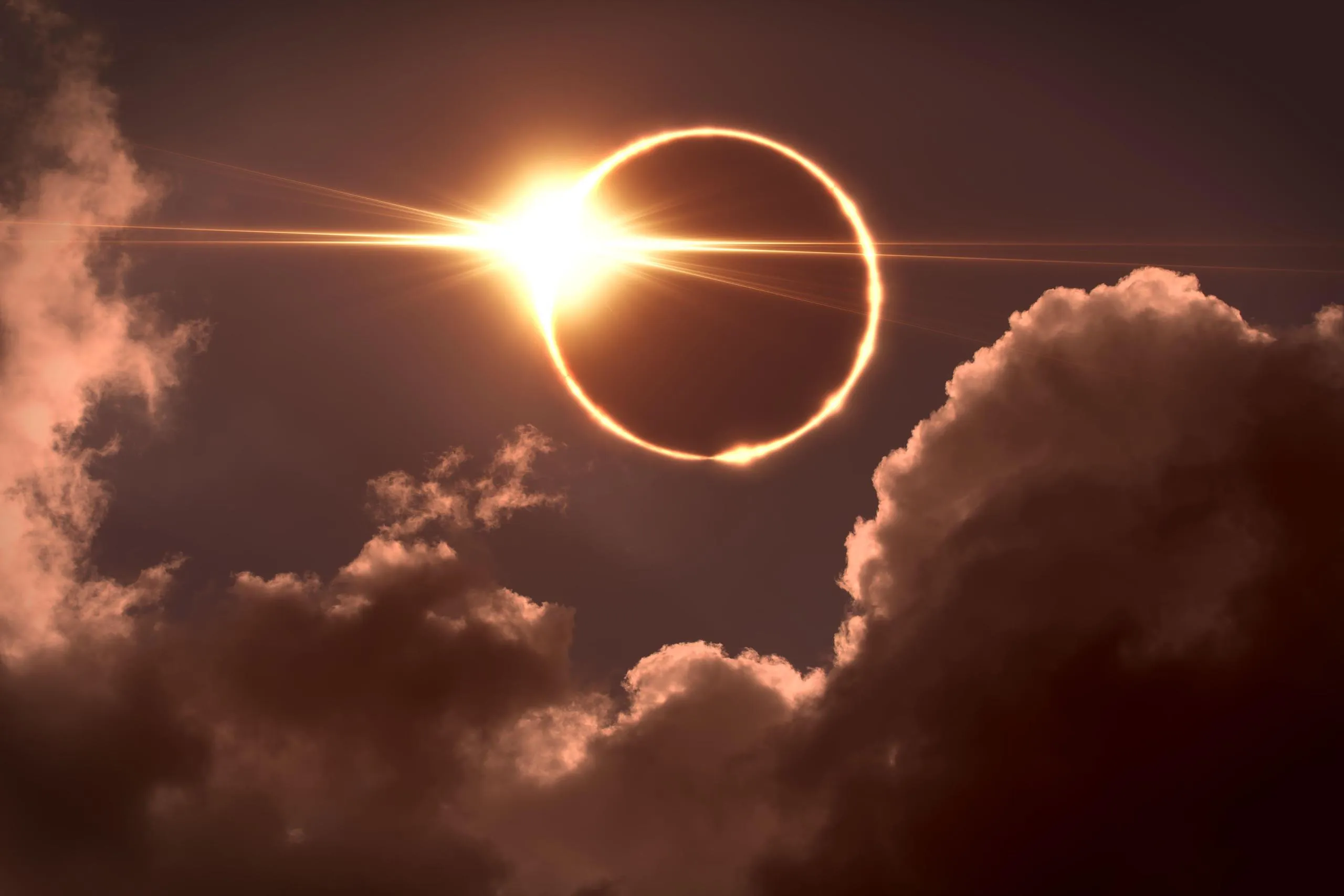
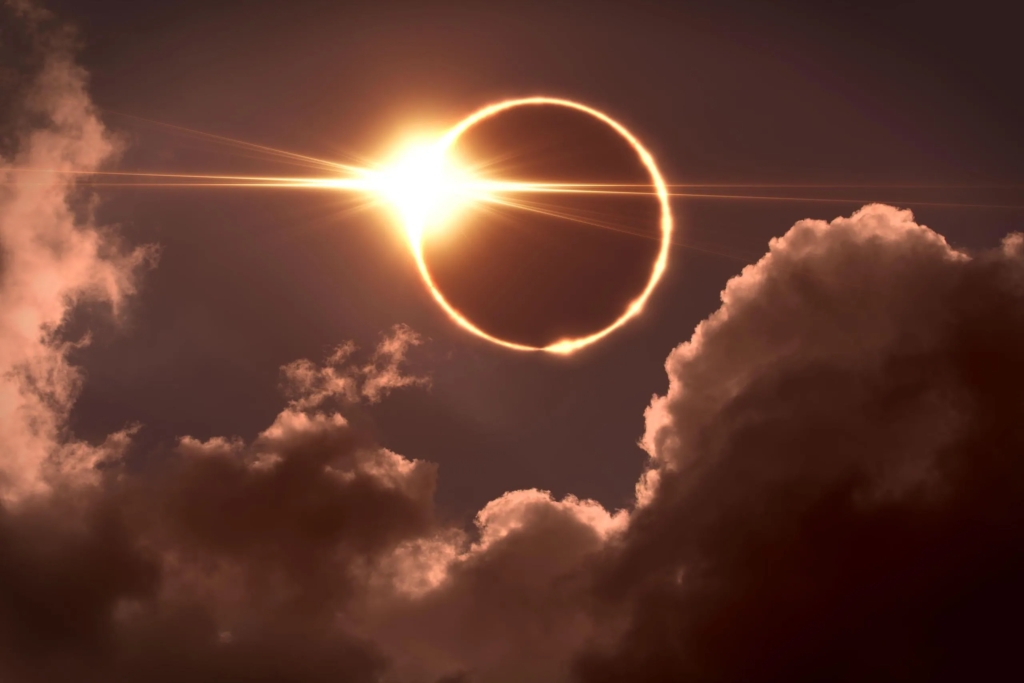
The Diamond Ring Effect: The Diamond Ring Effect is a signal that the total solar eclipse has arrived: as the last Bailys Bead gleams the dark silhouette of the Moon becomes entirely surrounded by a faint glowing halo of the Sun. For a split second the sky resembles a glowing diamond ring. This is the final signal that the total solar eclipse has arrived.
4. Totality
The diamond ring vanishes, and the sky plunges into deep twilight. The stars and planets become visible to the naked eye. This is the only moment during the entire event when it is safe to look directly at the sky without protective eyewear. Totality can last anywhere from a few seconds to over seven minutes, depending on your geographic location along the path.
Beyond the Sky: Environmental and Animal Reactions
When we look at what happens during an eclipse we have to think about how it affects the environment on Earth. The solar eclipse has an impact on the environment. When the Sun is blocked the ground gets cooler fast. This happens because the ground is not getting heat from the Sun.
The Thermal Response
The temperature can drop a lot when a solar eclipse happens. It can get cooler by 3°C to over 8°C in a few minutes. This is a change. The cooling of the air can also change the way the wind blows. Sometimes a gentle wind starts to blow when the solar eclipse is happening. This wind is called an “eclipse wind”.
The Biological Disruption
| Organism Group | Observed Behavioral Reaction | The Psychological / Biological Cause |
|---|---|---|
| Birds & Poultry | Songbirds suddenly stop singing; chickens and geese return to their coops to roost. | The abrupt dimming mimics natural dusk, triggering their instinctual sleep cycles. |
| Nocturnal Animals | Crickets begin chirping loudly; bats, owls, and moths emerge from hiding. | Fooled by the midday darkness, nocturnal creatures believe night has arrived early. |
| Domestic Pets | Dogs may whine, bark, or look toward their owners for reassurance. | Pets are highly sensitive to sudden changes in air temperature, light quality, and human anxiety. |
| Plants & Vegetation | Certain flowers and leaves close up or droop slightly. | Photosynthetic activity drops sharply, causing temporary changes in internal water pressure. |
The Varieties of Solar Eclipses
Not all solar eclipses are the same. The Moon does not always block the Sun. This is because the Moon is not always the distance from Earth. The Moons path around Earth is not a circle it is like an oval. This means that sometimes we see a solar eclipse and sometimes we do not.
Comparing Eclipse Profiles
| Eclipse Type | Moon’s Distance from Earth | What the Observer Sees | Direct Eye Safety Level |
|---|---|---|---|
| Total Eclipse | Closer to Earth (Perigee) | The Moon completely covers the Sun’s disk; the brilliant solar corona becomes visible. | Safe to view only during the brief window of 100% totality. |
| Annular Eclipse | Farther from Earth (Apogee) | The Moon is too small to cover the Sun fully, creating a striking “Ring of Fire.” | Never safe to view with the naked eye at any point. |
| Partial Eclipse | Varied | The Sun, Moon, and Earth are not perfectly aligned; the Sun appears as a crescent. | Never safe to view without certified solar filters. |
Eye Safety: The Golden Rule
The important thing to know about a solar eclipse is how to watch it safely. We have to be careful when we watch an eclipse. Even when most of the Sun is blocked the small part that is still visible can hurt our eyes. This is because the Sun is still very bright. If we look at the Sun during an eclipse it can hurt our eyes and cause blind spots. This is called retinopathy. It is a condition where the bright light from the Sun hurts the cells in our eyes.
We have to be careful when we watch an eclipse. A solar eclipse is an event. We have to know how to watch an eclipse without hurting our eyes. The Sun is still very bright, during a solar eclipse. So we have to be careful and take care of our eyes when we watch an eclipse.
- Always Use ISO-Certified Glasses: Standard sunglasses, polarized lenses, and dark film negatives cannot protect your eyes. You must use specialized solar viewing glasses that conform to the ISO 12312-2 international safety standard.
- Inspect Your Filters: Before looking at the sun, ensure your eclipse glasses have no scratches, pinholes, or tears. If they are damaged, discard them immediately.
- The Totality Exception: The absolute only time you can safely remove your eclipse glasses is during the exact window of 100% totality, when the Sun’s bright face is completely hidden behind the Moon. The moment the first bead of light reappears on the opposite side, the glasses must go back on.
Final Thoughts: A Moment of Unity
A solar eclipse is a powerful reminder of our place in the cosmos. It strips away our modern digital distractions and forces us to look upward in collective wonder. As the Moon’s shadow sweeps across the continents at thousands of miles per hour, it connects us directly to the predictable, clockwork rhythms of our solar system.
By understanding the delicate mechanics of the alignment, the step-by-step timeline of totality, and the unique environmental shifts that follow, you can transform your viewing experience from a simple optical curiosity into a profound, lifelong memory. Plan ahead, secure your certified glasses, and prepare to stand in awe of the great celestial dance.