For skywatchers and amateur astronomers across India, the early mornings of mid-April have transformed into a celestial theater. As we move through the second half of the month, a rare “Software-Defined” cosmic arrangement is taking place on the eastern horizon. The four-planet parade in April 2026—featuring Mercury, Mars, Saturn, and Neptune—is currently at its peak visibility, offering a spectacular reason to wake up before the sun.
While planetary alignments (often called “planet parades”) are not entirely uncommon, seeing four distinct worlds cluster within a tight two-degree window is a rare “vibe” that won’t repeat in this exact configuration for several years. Whether you are in the bustling streets of Mumbai or the clear highlands of Ladakh, here is everything you need to know to catch this pre-dawn show.
When and Where to Watch in India
The window for the four-planet parade in April 2026 is relatively short but highly rewarding. The alignment is visible from April 16 to April 23, but the absolute best viewing window falls between April 18 and April 20.
Timing is Everything:
In India, the optimal time to look up is roughly 30 to 45 minutes before local sunrise. For most Indian cities, this translates to a viewing window between 5:00 AM and 5:45 AM IST.
- The Horizon Factor: You must have a clear, unobstructed view of the eastern horizon.
- The Light Trap: Once the sky begins to brighten with the coming dawn, the fainter planets like Saturn and Neptune will quickly wash out.
The Lineup: Who’s Who in the 2026 Parade?
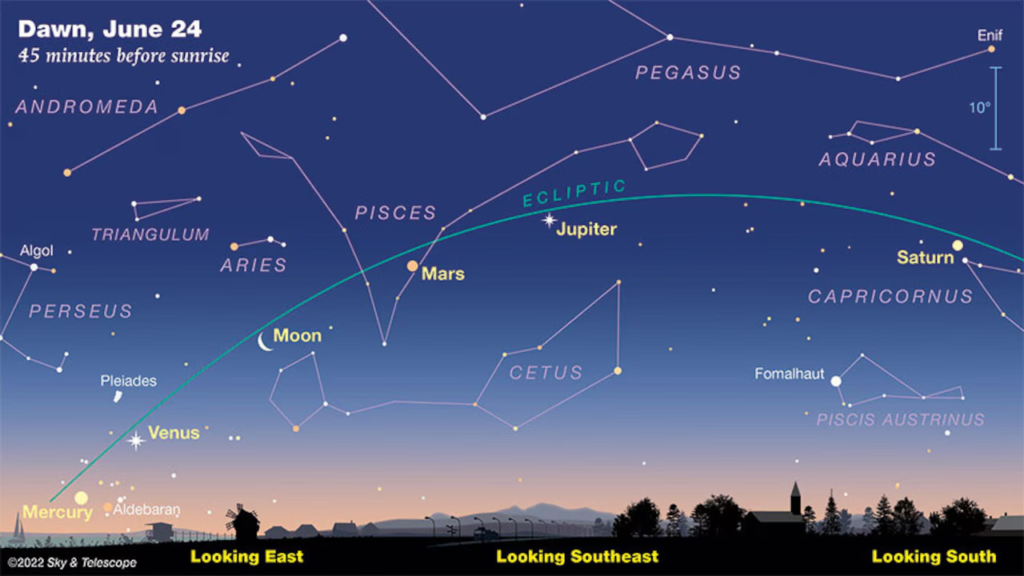
During this four-planet parade in April 2026, the planets don’t form a perfectly straight line in space—they only appear that way from our “Software-Defined” perspective on Earth. They are millions of kilometers apart, yet they currently share the same segment of the ecliptic path.
1. Mars: The Red Beacon
Mars is the easiest to identify in this grouping. Positioned higher in the sky than the others, it sports a distinct reddish-orange tint. It is bright enough to be seen easily with the naked eye even from light-polluted urban areas.
2. Mercury: The Low-Lying Spark
Mercury sits lowest on the horizon. While it is technically the brightest of the group, its proximity to the rising sun makes it a challenge. Its visibility is expected to sharpen toward April 20 as it moves slightly higher.
3. Saturn: The Pale Yellow Jewel
Slightly above Mercury, you will find Saturn. It appears as a steady, pale yellow point of light. While visible to the naked eye, a pair of binoculars will help distinguish it from distant stars.
4. Neptune: The Invisible Outlier
Neptune is the highest of the four, but it is not visible to the naked eye. To see the eighth planet, you will need a telescope or high-powered binoculars. It appears as a tiny, dim blue dot, and finding it requires a bit of patience and a steady hand.
How the Formation Changes Daily
The exciting part of the four-planet parade in April 2026 is that it isn’t a static image. Because each planet orbits at a different speed, the “vibe” of the alignment shifts every morning.
- April 16–19: The planets form a tight, pyramid-like triangular configuration.
- April 20: This is the “Showcase Morning.” Mercury, Mars, and Saturn will form a striking diagonal line, creating the most recognizable “parade” formation.
- April 21–23: The line begins to break apart as Mercury drifts closer to the sun and Mars moves further away.
Viewing Tips for Success
To get the most out of the four-planet parade in April 2026, follow these “Software-Defined” amateur astronomy best practices:
- Find a Dark Spot: While Mars and Mercury are bright, stray city lights can make Saturn harder to spot. Find a rooftop or an open field.
- Use an App: Tools like Star Walk or Stellarium can help you point your phone at the sky to identify exactly which “star” is actually a planet.
- Avoid the Sun: Never point binoculars or a telescope at the horizon once the sun has started to peek over. This can cause permanent eye damage.
- Be Patient: Atmospheric haze near the horizon often makes planets look like they are “twinkling” or disappearing. Give your eyes 10 minutes to adjust to the pre-dawn darkness.
Why This Alignment is Special
Planetary alignments like the four-planet parade in April 2026 are a reminder of our place in the solar system. While three-planet groupings happen every year or two, a four-planet cluster this compact is a relatively rare event. It allows educators and parents to show the “ecliptic”—the imaginary flat plane on which all planets orbit the sun—visually and clearly without any complex equipment.
A Cosmic Wake-Up Call
The four-planet parade in April 2026 is a fleeting event that rewards the early risers. It’s a moment of quiet connection with the cosmos before the daily “Software-Defined” hustle of life begins. Whether you are a seasoned astronomer with a tripod or a curious observer with just your eyes, don’t miss the chance to see four worlds gathered in a single frame of your morning sky.
If the skies are clear over your city tomorrow morning, set your alarm and look East. The planets are waiting.
Frequently Asked Questions (FAQs):
Can I see the four-planet parade in April 2026 from my city in India?
Yes, the alignment is visible across all of India. The best views will be from southern and central regions where the eastern horizon is often clearer, but it is visible nationwide roughly 30-45 minutes before sunrise.
Do I need a telescope to see all four planets?
No, you can see Mercury, Mars, and Saturn with the naked eye under clear conditions. However, Neptune is too faint for human eyes and will require a telescope or powerful binoculars to spot.
What happens if it is cloudy on April 20?
The four-planet parade in April 2026 is a week-long event. If it’s cloudy on the peak day (April 20), you can still see a very similar formation on April 19 or April 21. The planets stay in the same general area of the sky throughout this window.