The universe isn’t just a silent, empty expanse—it’s more like a bustling system where one star’s birth can shape the futures of thousands of others. A big study from 2026 cracked open a new layer of this mystery, showing how intricate feedback loops steer what happens in our galaxy. Basically, the researchers found that giant stars call the shots, controlling how other stars pop up in nearby molecular clouds. This idea explains why some pockets of space burst with new suns, while others just sit there, empty and still.
Those molecular clouds—people call them “stellar nurseries”—are thick blankets of gas and dust, kind of like the raw ingredients for stars. Gravity tries to pull all that stuff together, but it’s not a gentle process. Actually, it’s pretty wild. The new research says enormous stars, the real heavyweights in these clusters, use their powerful radiation and fierce winds to boss around their smaller neighbors. Sometimes, they jumpstart the process; other times, they slam on the brakes.
1. The Mechanism of Stellar Feedback
When people talk about massive stars controlling star formation in nearby molecular clouds, they mean “stellar feedback.” These huge stars, way bigger than our Sun, blast out intense ultraviolet radiation and strong stellar winds. All that energy messes with the surrounding cold gas in a few ways:
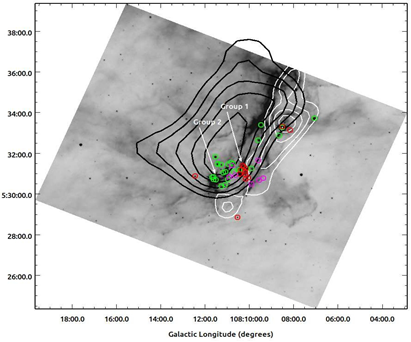
- Photoionization Heating: Intense light heats up the nearby gas, bumping up the pressure and keeping gravity from squeezing it into new stars.
- Mechanical Shocks: The stars’ winds punch through the gas, creating huge bubbles—kind of like clearing out space so there’s nothing left to make new stars. And sometimes, surprisingly, those winds press so hard they actually force a gas cloud to collapse, spark a new round of star formation, and kick off a fresh generation.
- Triggered Collapse: So, this “stellar feedback” isn’t just some background theory. It’s the reason star creation is unpredictable—from one cosmic neighborhood to the next.
2. Cosmic Regulation: A Statistical Overview
Without this regulation, galaxies would burn through their gas way too fast. You’d get a wild burst of star formation—then nothing but darkness for billions of years. Massive stars step in as regulators, keeping things balanced. They slow down the whole process, so galactic evolution stays steady and gradual.
Stellar Regulation Impact Matrix
| Force Type | Source | Effect on Molecular Cloud | Outcome for Star Formation |
| UV Radiation | Massive O-Type Stars | Increases gas temperature and pressure. | Suppression (Prevents collapse). |
| Stellar Winds | Wolf-Rayet Stars | Creates high-velocity physical shocks. | Dispersal (Clears star-forming gas). |
| Supernova Remnants | Dying Massive Stars | Injects heavy elements and turbulence. | Enrichment & Triggered Birth. |
3. High-Tech Observation in 2026
Today’s astronomers depend on a pretty robust mix of tech—both digital and physical—to handle the mountain of data needed to prove that massive stars are the key players in regulating star formation nearby.
- Multi-Wavelength Data: They look at multi-wavelength data. That means combining infrared telescopes (to see through dusty regions) with radio telescopes (for tracking cold gas), giving them a clear map of how feedback loops work.
- Secure Research Portals:Researchers in India, for example, tap into global observatories over high-speed networks. Sometimes, they use their Aadhaar-linked mobile numbers for multi-factor authentication to access secure research servers and supercomputing clusters.
- Data Archiving: After gathering results, scientists archive their findings in digital vaults like DigiLocker or institutional repositories. This protects the research’s digital authenticity—its ‘e-Aadhaar’—when it goes up for peer review.
- Financial Grants: On the money side, funding usually gets funneled into designated zero balance bank accounts, just for government grants. It keeps the tracking clean and transparent for all that public money spent on deep-space research.
4. Why This Discovery Matters
Unraveling how massive stars control star formation isn’t just for the sake of theory. It actually helps us understand planetary systems—including our own.
- Chemical Enrichment: These stars produce heavy elements like carbon, oxygen, and iron, all of which end up in planets eventually.
- Solar System History: Our own solar system’s history points to the Sun being born in a cluster with massive stars.
- Galactic Life Cycles: By studying nearby molecular clouds, we get clues about the future star-forming potential of far-off galaxies. It’s all connected—each discovery helps unlock the bigger picture of life in the universe.
5. Comparative Efficiency of Star Formation
| Environment | Regulation Level | Star Formation Rate (SFR) | Cloud Longevity |
| Dense Cluster | High (Many Massive Stars) | Regulated / Steady. | Long (Gas is preserved). |
| Isolated Cloud | Low (Few Massive Stars) | High / Rapid. | Short (Gas is used up quickly). |
| Galactic Center | Extreme (Black Hole + Stars) | Variable / Turbulent. | Unstable. |
FAQs: Massive Stars and Molecular Clouds
What exactly is a molecular cloud?
A molecular cloud is a cold, dense region of the interstellar medium composed mostly of hydrogen molecules ($H_2$). It is the only place in space where the environment is stable enough for gravity to create new stars.
Are massive stars always “bad” for star formation?
No. While they often suppress star formation by heating gas, they are also responsible for “triggering” it by compressing gas in distant parts of the cloud. It is a delicate balance of regulation.
Can I track these scientific updates on my phone?
Yes. Most major scientific journals and the Department of Science and Technology (DST) have mobile-optimized portals. For secure access to premium research, you might need to use your Aadhaar-based login for verification through official apps. Ensure your mobile number is linked to your ID to receive the necessary OTPs.
Why is a zero balance bank account mentioned for research?
In the 2026 academic ecosystem, many PhD scholars and research institutes use a zero balance bank account to receive government stipends and project funds. This avoids the burden of maintaining a high minimum balance while providing a clean financial trail for audit purposes.
The Cosmic Balance
The discovery that massive stars regulate star formation in nearby molecular clouds highlights the interconnectedness of the universe. A single massive star can act as a lighthouse, a furnace, and a wall—all at once. As we refine our digital tools and observation techniques, we continue to learn that the “chaos” of space is actually a finely tuned system of regulation that allows galaxies to thrive over billions of years.