An unexpected electrical malfunction disrupted daily operations at the heart of Gujarat’s administrative capital. According to early updates from local authorities, a short circuit incident reported at Gandhinagar Secretariat (New Sachivalaya) has left three maintenance staff members injured.
The incident triggered an immediate emergency response, with local fire department crews and medical teams arriving on the scene within minutes. While the underlying electrical spark was quickly contained before spreading into a major structural blaze, the event has raised serious questions regarding building maintenance schedules and power grid infrastructure safety within high-profile state government complexes.
Incident Breakdown: How the Electrical Flash Occurred
The accident occurred inside one of the main administrative wings where key state departments operate. Eyewitnesses reported a sudden, loud pop followed by thick smoke rising from an electrical service shaft panel.
Immediate On-Site Impact
The three injured individuals, who were part of the on-duty technical maintenance crew, were standing in close proximity to the distribution panel when the flash occurred.
- Nature of Injuries: The workers sustained varying degrees of surface burn injuries and smoke inhalation complications.
- Medical Response: On-site security teams moved quickly to evacuate the affected area. The injured personnel were rushed via emergency ambulances to the civil hospital for immediate medical care. Doctors have confirmed they are currently stable and under close medical observation.
Structural Assessment: Secretariat Layout and Impact Zone
The Gandhinagar Secretariat complex houses several high-level government offices, including the General Administration Department (GAD) and various ministerial chambers. Managing electrical infrastructure across these expansive multi-story blocks requires constant vigilance.
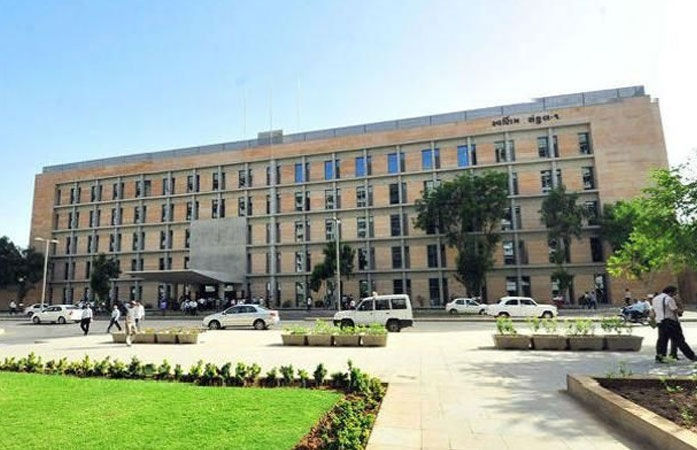
The table below outlines the operational status and damage control assessment following the morning’s incident:
| Sector Block Identifier | Primarily Occupied Departments | Immediate Damage Assessment | Current Operational Status |
| Block 1 & 2 (Core Impact Zone) | General Administration, IT Infrastructure | Server panel damage, localized smoke staining | Partially suspended; operating on backup power |
| Block 3 to 5 | Finance, Revenue, and Home Departments | None; isolated minor voltage fluctuations | Fully functional; standard grid power |
| Block 7 & 8 | Agriculture, Water Resources, Education | No damage reported across lines | Fully functional; standard grid power |
| Ministerial Bungalow Area | Executive Legislative Chambers | Completely unaffected by the local short | Fully functional |
Emergency Countermeasures and Safety Audits
Following the short circuit, senior administrative officials and public works engineers ordered an immediate, comprehensive review of the entire block’s electrical wiring network.
To prevent similar accidents in neighboring government sectors, the state maintenance division has put an immediate multi-step safety protocol into action:
1.Isolate the Affected Grid Segment:Isolation Phase.
Cut off main grid electricity to the entire impacted wing to eliminate any lingering risk of secondary fires or unexpected high-voltage feedback loops.
2.Ventilate Corridors and Server Rooms:Atmospheric Clearing.
Deploy commercial exhaust fans to clear out toxic plastic smoke and acrid fumes from closed office spaces, making it safe for safety inspectors to enter.
3.Replace Damaged Circuit Components:Hardware Diagnostic.
Strip away compromised internal copper wiring, burnt out fuses, and warped switches, replacing them with modern, fire-retardant circuit elements.
4.Launch a Complex-Wide Thermal Audit:Future Prevention.
Deploy engineering teams equipped with handheld infrared thermal cameras across all secretarial blocks to scan hidden wiring nodes for dangerous hotspots or overloaded circuits before they can fail.
⚠️ Official Safety Advisory: The building maintenance division has requested all department heads to limit the use of heavy, non-essential electrical items—such as high-wattage personal space heaters or multi-plug extension arrays—until the main power grids finish undergoing full certification checks.